
I Knew China. Apparently.
Almost forty years of visits, and one week in Shanghai and Hangzhou still rearranged my assumptions. We are not as far ahead as we think. And China is not quite what it shows you.
by Roger Sharp
Shanghai was eerily quiet. Electric vehicles had taken the soundtrack out of the streets. There was still the occasional horn, but the diesel growl had largely gone. The cameras, meanwhile, were everywhere.
I have been visiting China for almost forty years. I thought I knew it. This time, the surprise was how thoroughly technology had entered ordinary life. AI and robotics kept turning up in transport, shopping, healthcare and the small transactions that make a city work.
For anyone running a technology business, that matters. Useful products reset what customers expect. Businesses that deploy them quickly can reset consumer behaviour and even the economics of an industry. Neither waits for us to finish discussing the implications.
On a visit to China, there is what your hosts want you to see, what you actually see, and what you work out afterwards. Our week provided plenty of all three. Shanghai and Hangzhou are hardly a cross-section of the country, and the corporate visits we did were carefully choreographed. China curates its own story with great skill. Visitors need to look beyond the dazzling story craft to work out what lies beneath. Even allowing for that, there was a great deal to learn. What follows is a set of observations, not a verdict on anyone’s system of government.
From ox carts to algorithms
My wife and I first visited Shenzhen in 1987. There were ox carts and a snake charmer with a cobra in an open-air market. Later came several years living and working in Hong Kong, before, during and after the handover, with regular visits to the mainland for IPOs and capital raisings.
In those days the bank I worked for was raising money for both Taiwanese and mainland companies. The contrast was stark. In Taiwan we did deals with legendary technology companies such as TSMC, UMC and Hon Hai Precision, better known as Foxconn. On the mainland, our clients were basic industrial companies like Hainan Motorcycle and Yanzhou Coal.
There were more visits over the years, most recently in 2019. Then came Covid and a gap that, in technological terms, now feels much longer than seven years.
This time, a maglev train swept past us as we left Pudong Airport. Multi-lane roads stretched away through extraordinary infrastructure. Over the decades, bicycles gave way to motorbikes, then to the noise (and fumes) of diesel trucks and cars, and now to the hush of electric vehicles. Ox carts to maglev in one working lifetime. Mine.
What we were shown
Our Queenstown local government and business delegation visited REDnote, Trip.com, Alibaba, Geely and robot-maker Unitree, then a local government showcase in Hangzhou that presented an equally polished account of technological progress. Throughout, we were led by accomplished hosts showing us their best work. The multimedia presentations were impressive. I deviated from the group one day to visit local tech companies to try to get an unvarnished view.
China is an important and fast-growing market for our tourism industry Down Under. It takes skill to understand, navigate and master as an English-language tourism operator. The questions on everyone’s lips were practical. How do you make your destination visible inside the Chinese platforms? How do you turn that visibility into bookings? Who owns the customer? And who provides the customer service when things go wrong?
At REDnote, the social media platform, we saw how an online community can drive demand for destinations. Live statistics showed the level of interest in Queenstown, then sliced and diced it. Destination Queenstown, our local tourism body, drew more than 7,000 likes and hundreds of comments within hours of its first post. It turns out that thousands of Chinese people love Queenstown. Who’d have thought the first thing they want to do when they get there is jump out of a plane?
At Trip.com, the story was one of scale and global reach, again with impressive statistics backing up the macro pitch. This is a business that can drive visitation at scale. For a destination such as Queenstown, or any destination for that matter, it is a relationship worth getting right.
At Alibaba we received the full corporate pitch. This is a powerhouse that is making travel yet another service in a full stack of the things you need to live your life. A representative of Fliggy, its travel platform, talked us through the business it is doing Down Under. When I asked for operational details (‘who is the Merchant of Record, and who provides customer service?’) and for a comparison between Trip.com and Fliggy, the answers ran out. Perhaps it was a language thing, or simply a question of who was in the room. Then again, maybe not. It reinforced our impression that we were being managed, and that the slick presentations were designed more for transmission than for interrogation.
At Geely, we saw a wide range of house brands. The finish, the design and the apparent quality for the price prompted plenty of exchanged glances across the group. Some of the brand names prompted a different sort of glance. Will Zeekr and Lynk & Co roll off Western tongues? The engineering appeared to be progressing rather faster than the naming department.
There is a serious point behind the joke. Selling overseas takes trust, recognition and an understanding of the customer, as well as a good product. But anyone still assuming that Chinese design and finish are inferior would have found that showroom uncomfortable.
At Unitree, dancing and kickboxing robots demonstrated remarkable mechanical capability. The kickboxing was fun, although it was hard not to wonder what such machines might one day be used for. Then we came across a room that was not on the tour, full of inert robots. Broken down or simply out of battery, it was hard to tell. We promptly named it the Dead Robots Society.
Even the future, apparently, needs a lie-down.
We also noticed human controllers behind some of the performances. A robot running a rehearsed routine under human control is not a machine working independently through an unpredictable day. The engineering was impressive. The show was still a show. Reliability, autonomy and the cost of keeping the machines running will decide how useful it becomes.
The inevitable debate erupted, of course: whose AI and robotics are ahead, China’s or America’s? Everyone had a view. Nobody had the data. The only honest answer is an A/B test: same task, both machines, see which one is left standing.
What we saw for ourselves
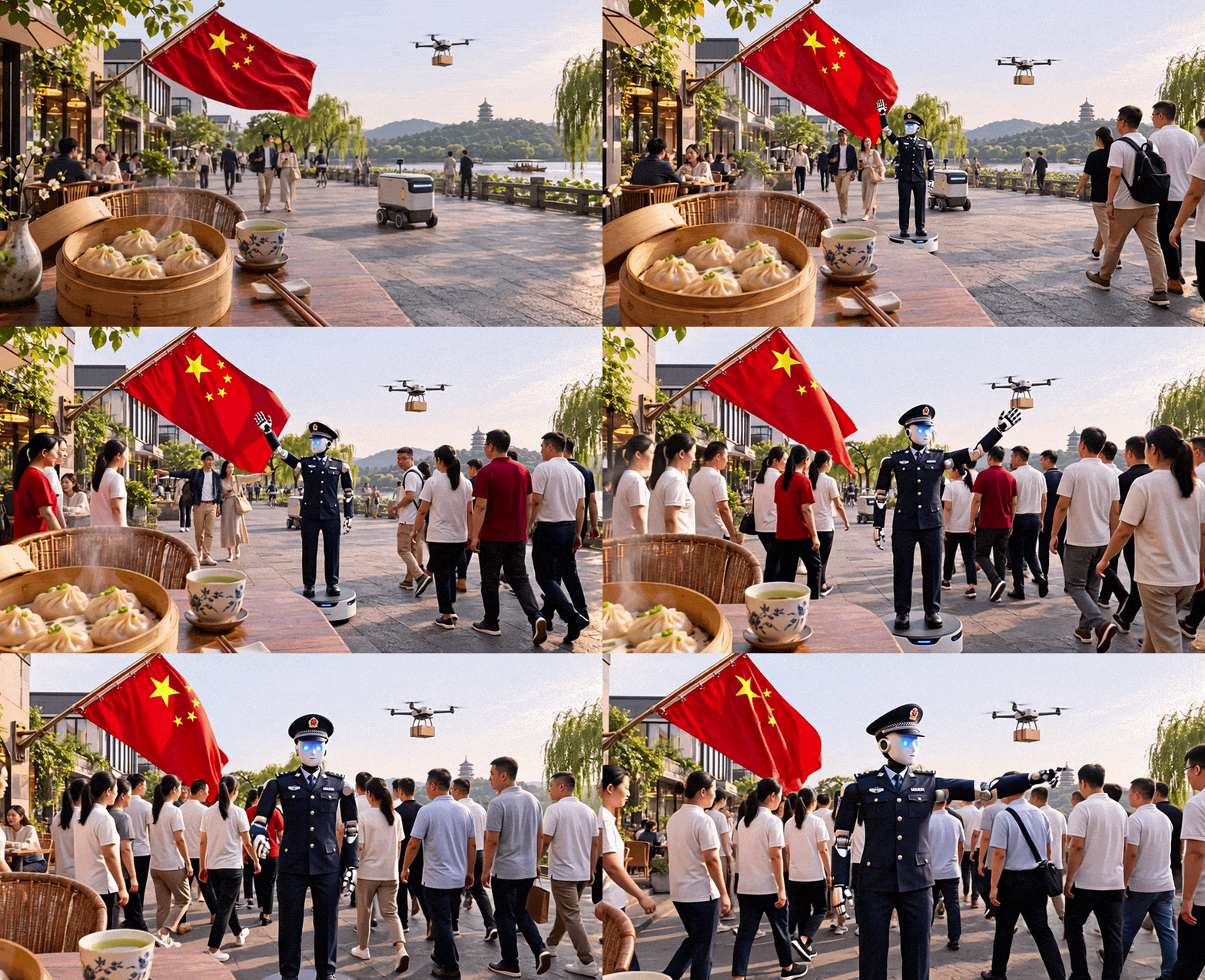
Once we left the corporate presentations, digital technology was pervasive in daily life on the street. A robotic traffic policeman at an intersection. Facial recognition. Women getting AI facials (yes, AI facials!). And so much more. Not everything we saw depended on AI, but the appetite for putting technology to work was striking.
Hangzhou, one of China’s leading robotics hubs, offered a practical example. Government officials said they were actively using AI to solve everyday problems. They described controlling traffic lights to give ambulances a clear run to hospital, when minutes save lives.
Our group, led by the Mayor of Queenstown, experienced traffic-light priority first-hand under a police escort, with lights miraculously turning green as the vehicles approached. We could not tell how much of that was algorithm and how much was police intervention, but the ability to coordinate traffic was hard to argue with.
The larger lesson was the determination of local government to put technology to work. The officials we met had the ambition, and a system of control that lets them act on it. That capacity to carry a useful idea through to delivery is what too often seems missing at home.
Back in Shanghai, Xintiandi’s luxury seemed almost to outdo Beverly Hills. The shopping was immaculate, apart from an occasional contribution from the drains. The whiff of raw sewage isn’t a comfortable bedfellow for high-end luxury. Neither the shops nor the showrooms, however, told us much about the pressure on the businesses behind them.
A private conversation with a technology founder was revealing. They described widespread deflation and negative equity as serious problems, and pointed to apartment blocks standing empty. All of this was forcing the company to seek new business outside China. Overseas expansion offered a route to growth, but winning business abroad was proving much harder and slower than expected (yes folks, geopolitics is a thing). Good technology does not sell itself internationally.
Then came the surprise. The company charges per seat, takes a revenue share and bills for AI tokens. It had built an AI layer on top of its product and was charging customers by usage. Asked whether it ran on Qwen or DeepSeek, management gave an unexpected answer: one of the US frontier models, which they said performed well and cost half as much as DeepSeek for their particular use case.
Savour the irony: a Chinese technology company selling AI to Chinese customers, powered by an American model, and trying to take that product to the world. It chose the model on price and performance. The flag on the box told us rather little about what was inside. Dependencies, it turns out, run in both directions.
The ambulance test
Gallup’s recent research with Microsoft puts a number on the difference in expectations between countries. Among adults aware of AI, 93% in China said it would mostly help people in their country, the highest of the 37 countries surveyed. In the United States the figure was 36%, close to the bottom.
Our impression was that everyday experience explains much of the optimism. In the cities we visited, people can see technology making life more convenient, whether by arranging a ride, receiving a delivery or getting an ambulance through traffic. Call it the ambulance test: can ordinary people see technology doing something useful for them? That is a more persuasive argument than another abstract announcement about the billions being spent on data centres, or jobs being lost.
A poll cannot tell us what caused the difference, and responses to sensitive questions may be shaped by the environment in which they are asked. Was it a desire to conform, or the fruit of AI working in people’s daily lives? We could not tell, but the visit made the numbers easier to believe.
We in the West are throwing enormous amounts of money at large language models. What else are we doing? Where are the useful services, the routine deployments, the improvements customers can actually feel? A business does not need to build the best model in the world to use one well.
Confidence in AI grows when people experience something worth having. Getting useful services into daily life will do more for public support than another billion-dollar announcement.
Please insert a different country
There was one fairly conspicuous exception to all this efficiency: your correspondent.
My bank blocked my credit card when I connected it to Alipay. An eSIM bought explicitly for China did not work, so a prepaid China Mobile SIM followed, accompanied by multiple photographs and passport documentation. Google was out of reach. So was LinkedIn. As was WhatsApp. A separate phone and laptop, taken as a precaution, made everything less familiar still.
The causes varied. The effect was a reasonably seasoned traveller standing outside a remarkably capable digital system, looking in. Jetlagged, no communications, no data, no payments, no map, no language skills. It made for a fraught Sunday.
Once connected, a new digital life took shape: Didi, WeChat Pay, Alipay, Amap and Qwen, with Youdao for translation. Everything became much easier, albeit still unfamiliar. It made me think of Malcolm Gladwell’s book Outliers: we are all very adept at using the tools we know and have mastered; take them away and even simple tasks become harder. But despite the lack of familiarity, maps, rides, payments and translations all worked. When a chest cough struck, medicine arrived within twenty minutes. Friends described ordering forgotten ingredients while cooking and receiving them within five.
The walled garden was a good deal more comfortable once someone had opened the gate.
Daily life required holding two thoughts at once. Friends in Shanghai loved the convenience. Some also used the phrase “digital prison”. They could enjoy a delivery arriving in five minutes and still feel constrained by the system around them, which knows every little thing about their lives.
This is not an argument about whose system is better. China is what it is. A visitor can count the cameras. He cannot see what they do to people’s lives. To a Westerner, it feels a bit dystopian. But it didn’t stop us going, and it won’t stop us from visiting again.
The walled garden also holds a commercial lesson for any technology business. Inside an integrated ecosystem, customers get things done with almost no effort. Getting inside is another matter. An elegant service does not impress the customer who cannot register, connect or pay.
Which raises a question closer to home. How does a Chinese visitor feel on arriving in New Zealand or Australia? Can they pay the way they are used to, get connected, read the instructions and find their way around?
We want their business. Do we make it easy enough to give it to us?
Visitors also bring their service expectations with them. Someone used to resolving an everyday problem in minutes may take a dim view of being told that the relevant department opens on Monday.
What we worked out afterwards
A week of meetings cannot tell us what life is really like elsewhere in China. But it can unsettle assumptions about the quality of Chinese technology, the speed of its deployment and the service it makes possible.
We should ask why it takes us so long in the West to turn useful ideas into working services. There are legitimate debates about cost, consent and public priorities. There are also delays that contribute nothing to any of them.
For technology businesses, the next step is practical. Find the recurring customer frustration or the expensive manual task that AI could remove. Put it to work, measure the result, improve it. Judge Chinese products, as competitors and as partners, on their merits rather than our assumptions, while accounting for security and supply-chain risks. For tourism businesses, start with whether a Chinese visitor can find you, book you and pay you without a local guide to the technology.
I thought I knew China. But what I knew was a country that no longer exists. It has gone from snake charmers and ox carts to maglev trains, ubiquitous cameras and pervasive AI, all within a lifetime. The country puts on a great show, but the show is not the whole truth. There are dead robots behind the dancing ones, empty apartment blocks behind the five-star hotels, a whiff of sewage behind the luxury shops, and a great deal that no visitor is shown.
But still, behind the show, real things work, at a speed and a price that should unsettle anyone who assumes we in the West are comfortably ahead at putting technology to work. We are not.