
Famous for Something

July 2026
Why an alpine district of 50,000 people - the world’s adventure capital - is betting its next twenty years on becoming the Southern Hemisphere’s home of Travel & Hospitality Tech.
Queenstown Lakes District has a problem most towns would kill for. Three million visitors a year descend on a district of around 50,000 residents, drawn by mountains, lakes, bungy cords and pinot noir. In 2019, on broader visitor-economy estimates, tourism was thought to account for up to roughly half of local GDP and employment. It is one of the most successful visitor economies on the planet, and that is precisely the problem. When your economy runs on one engine, you had better hope the engine never stops.
In early 2020 it stopped. New Zealand sealed its borders for the better part of two years, and the world’s adventure capital discovered what an adventure economy looks like without many adventurers. The pandemic was a financial and social disaster for many local residents. The town that had spent decades perfecting the art of selling joy suddenly had far fewer people to sell it to.
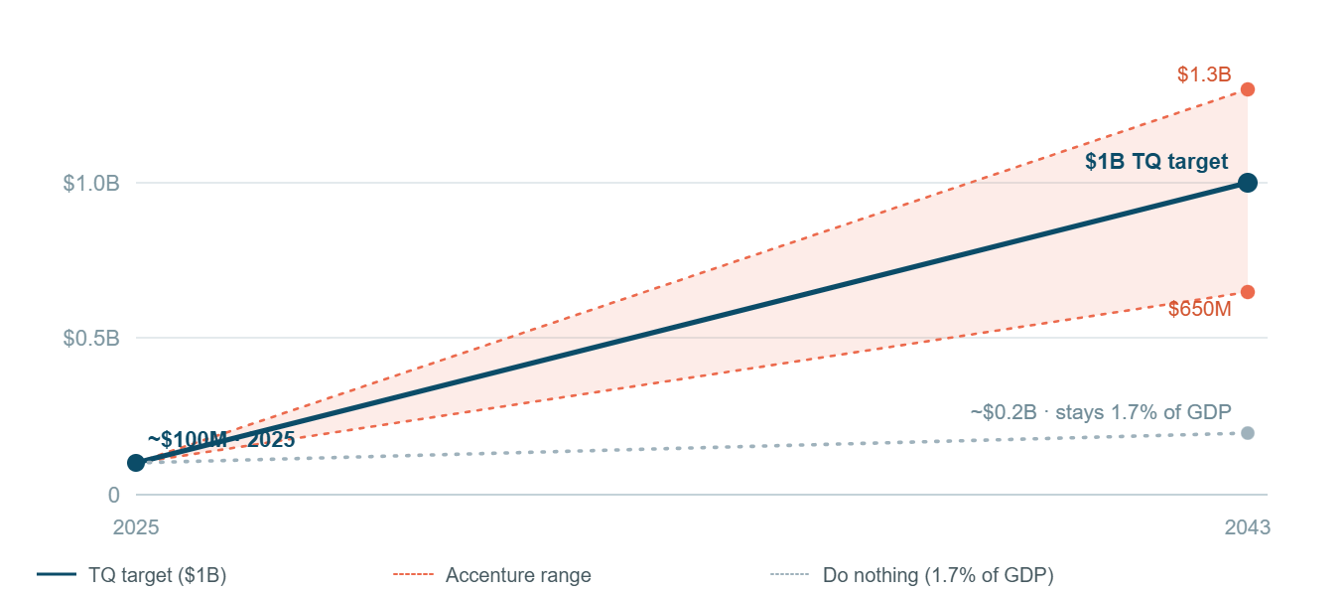
The Accenture projection: $650m–$1.3bn in annual tech GDP by 2043; TQ targets the ambitious end. Left to itself, the sector would drift along at ~1.7% of GDP.
A phone call, a road trip and a Fortune 500 economics unit
Out of that shock came a plan. At the height of the pandemic, then Queenstown Lakes Mayor Jim Boult started making phone calls to instigate a fledgling community effort to diversify the economy by building out its tech ecosystem. The brief was simple to state but brutal to execute: tourism plus something else.
What followed was unusually rigorous for a regional development story. There was at that time no plan for the district’s tech sector, there were no statistics, and there was certainly no register of who worked in it - not even a list of companies. So the team built the evidence base from scratch. Local economist Benje Patterson quantified the sector’s contribution. A senior researcher, funded by the council, by North Ridge Partners and by the University of Otago, wore out shoe leather meeting people and companies throughout the district. The findings surprised everyone: a wealth of tech talent had long been hiding in the hills around Queenstown, without a strategy, a spokesperson or a unifying vision.
The moment borders reopened, the desktop research went on the road. A trip through a dozen mountain towns in the western United States, from Bend and Spokane through Bozeman, Boulder and the length of the Colorado Rockies, surfaced a consistent recipe: successful alpine tech towns pair industry, academia and government, and in the best of them tech now accounts for up to 20 percent of economic output.
Then came the credibility multiplier. After a number of discussions, Accenture offered up its dedicated economics unit to write the analysis underpinning the strategy. Its white paper concluded that the district’s tech sector, then contributing roughly 1.5% of local GDP against a national average of 7.5%, could grow to between $650m and $1.3bn in annual GDP by 2043, deploying around 3,000 highly skilled tech workers and supporting a further 5,400 indirect jobs.
No one was going to dismiss lightly the modelling of a credible Fortune Global 500 company. Today, several years later, we credit Accenture’s commitment as a pivotal moment in the establishment of Technology Queenstown, or TQ.
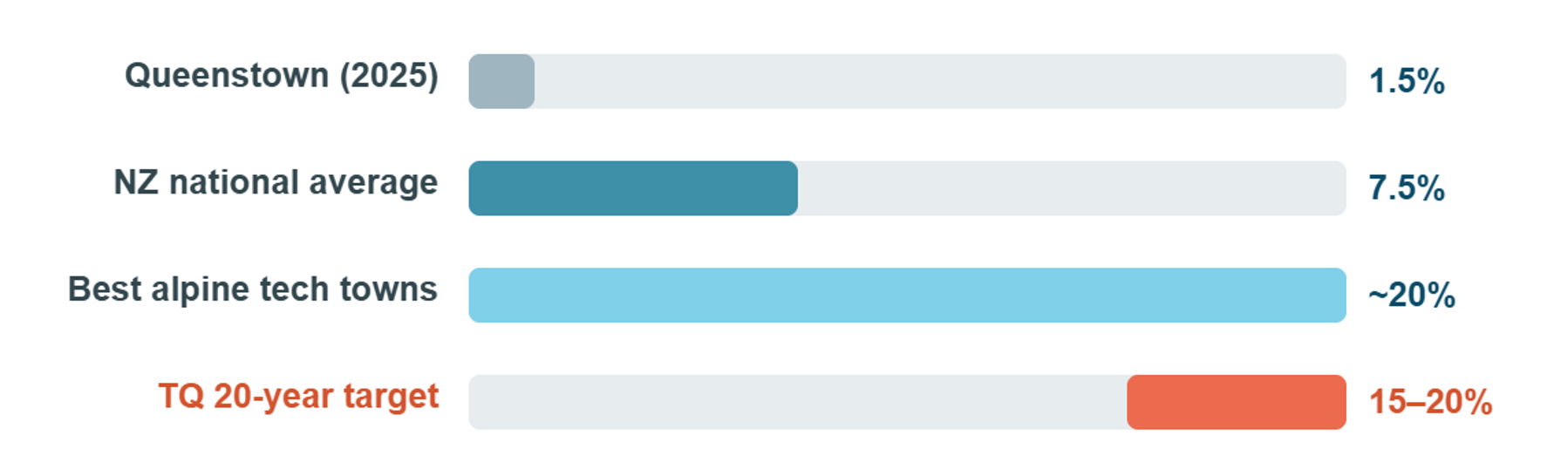
Tech as a share of the local economy. Each 1% of district GDP is worth >NZ$40m. Source: TQ / Accenture.
TQ launched as a not-for-profit development agency in January 2025, targeting the ambitious end of that range: $1bn in annual tech GDP within 20 years, lifting tech from under 2 percent to 15-20% of the local economy. Every 1% of the district’s GDP was then worth around NZ$40m, so simply reaching the national average would put roughly $240m a year more in the community’s pocket. The maths for every 1% more achieved over the national benchmark is compelling.
On the back of Accenture’s analysis, TQ began assembling a dream team of committed corporate sponsors. Its foundation membership reads like a who’s who of corporate New Zealand with a global garnish: Accenture, One NZ (telco), Genesis Energy (energy company), SBS Bank, the University of Otago, Russell McVeagh (law firm), Queenstown Resort College (education), the NZX (stock market operator) and North Ridge Partners, with the Queenstown Lakes District Council, Queenstown Airport and Destination Queenstown (DMO) adding strategic local muscle this year.
The strategy: don’t aim to be vaguely good at everything
The most important strategic decision came this year, and it is the one that separates TQ from a hundred well-meaning regional initiatives around the world. As TQ’s inaugural CEO Sarah Russell put it in announcing the move, the world’s best tech hubs refuse to be vaguely good at lots of things. Real reputation comes from focus, from building concentrated expertise that becomes internationally recognised, until the hub tips into a self-reinforcing snowball of growth.
Queenstown needs to be famous for something. So TQ is backing Travel & Hospitality Tech as the district’s first cluster.
The logic is almost embarrassingly obvious once stated. Queenstown Lakes already lives and breathes tourism: three million visitors annually, hundreds of operators within a 100 km radius, and nearly half the economy devoted to the craft of moving, housing, feeding and delighting travellers. That concentration of customers, use cases and domain expertise is exactly what Travel Tech founders spend fortunes trying to access. A hotel tech startup in most cities may have to fly to its customers. In Queenstown, the customers are the neighbours, and the entire district has the potential to function as a Southern Hemisphere testing ground for anything that improves the human travel experience. A number of homegrown companies are already generating export revenue across Travel & Hospitality Tech, so the cluster amplifies what exists rather than conjuring an industry from thin air.
The timing also matters: agentic AI is starting to rewire discovery, booking, servicing and operations across travel, which means the next generation of travel infrastructure is being designed now, not in ten years.
The ingredients: what the successful towns have
The research into overseas ecosystems distilled a checklist, and Queenstown is methodically ticking it off.
An international airport with high connectivity and flight frequency to domestic destinations and the east coast of Australia: check.
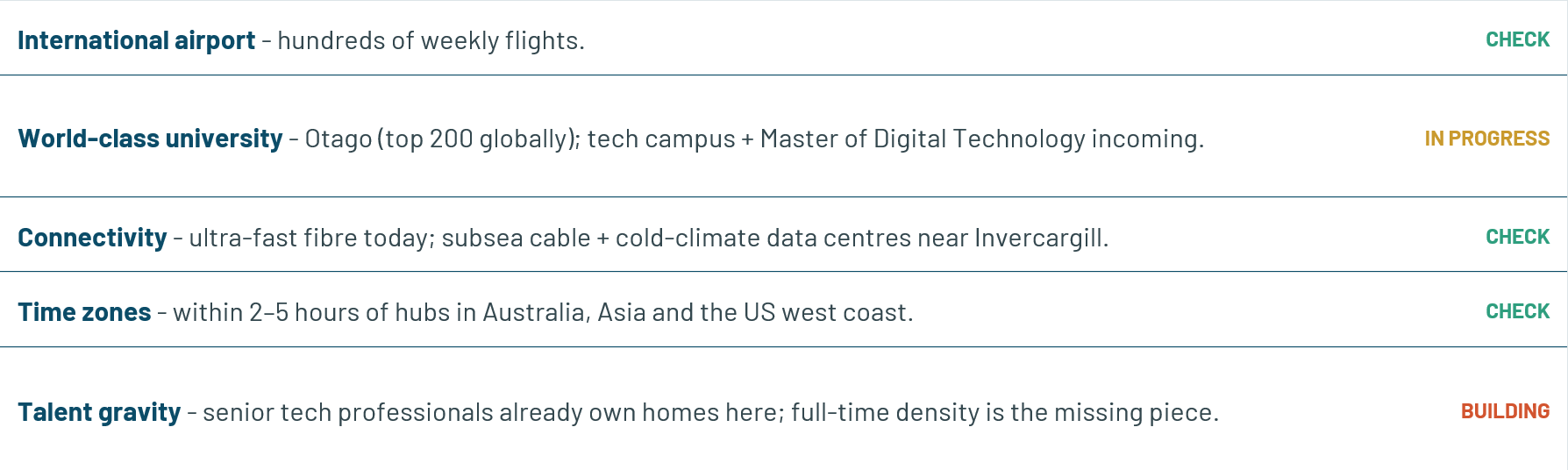
The ingredients: the recipe distilled from a dozen mountain tech towns, and where Queenstown stands against it.
A world-class university: in progress - the University of Otago (New Zealand’s oldest university and a global top-200 institution in the 2026 QS rankings), has seconded Professor Richard Barker to Queenstown to establish its tech campus and plans to launch its Master of Digital Technology there in 2027. Queenstown Resort College already teaches machine learning, data analytics and cloud computing, and TQ is working with both institutions to align curricula with what a Travel Tech workforce will actually need.
You cannot get famous for something without a workforce able to take up the challenge.
Connectivity: the district has ultra-fast fibre today, with subsea cable projects and renewably powered data centres proposed for Invercargill, two hours south, where the naturally cold climate cuts cooling costs.
Time zones: New Zealand has workable overlap with Australia, much of Asia and the US West Coast, especially for distributed teams used to asynchronous work.
Talent gravity: the district is already a magnet for digital nomads, founders and senior tech professionals who have bought homes there. That last point is the quiet superpower. Most regions must manufacture reasons for talented people to move there. Queenstown’s problem has only ever been giving them world-class work once they arrive.
Basecamp: a name for the next climb
Getting famous requires more than a conference and a curriculum. It requires a reason for the world’s travel technologists to keep coming back, and TQ’s answer carries a working title borrowed from mountaineering.
Basecamp is a proposed Travel Tech innovation facility for Queenstown, structured as an international problem-solving centre for travel, aviation and tourism, a deliberately more ambitious brief than the standard regional incubator playbook. There is currently no place in New Zealand where industry participants can go to solve systemic travel-sector problems, and Basecamp is being designed to fill precisely that gap.
The candidate problem / wish list reads like the sector’s collective anxiety dream: agentic AI transforming booking from discovery to autonomous execution, dynamic management of tourist flows to address both over and under tourism, future airport design that improves customer experience while streamlining opex, the identification and targeting of high-value visitors to shift the industry from volume to value, and the sector’s stubborn dependence on fossil fuels. Each is international in scope, commercially relevant and painfully real for operators.
A working group of senior university, corporate and tourism representatives has been convening with TQ to begin shaping the Basecamp framework, and development will be deliberately iterative from here.
A tale of three cities: how Edinburgh, Barcelona and Montreal build Travel Tech startups
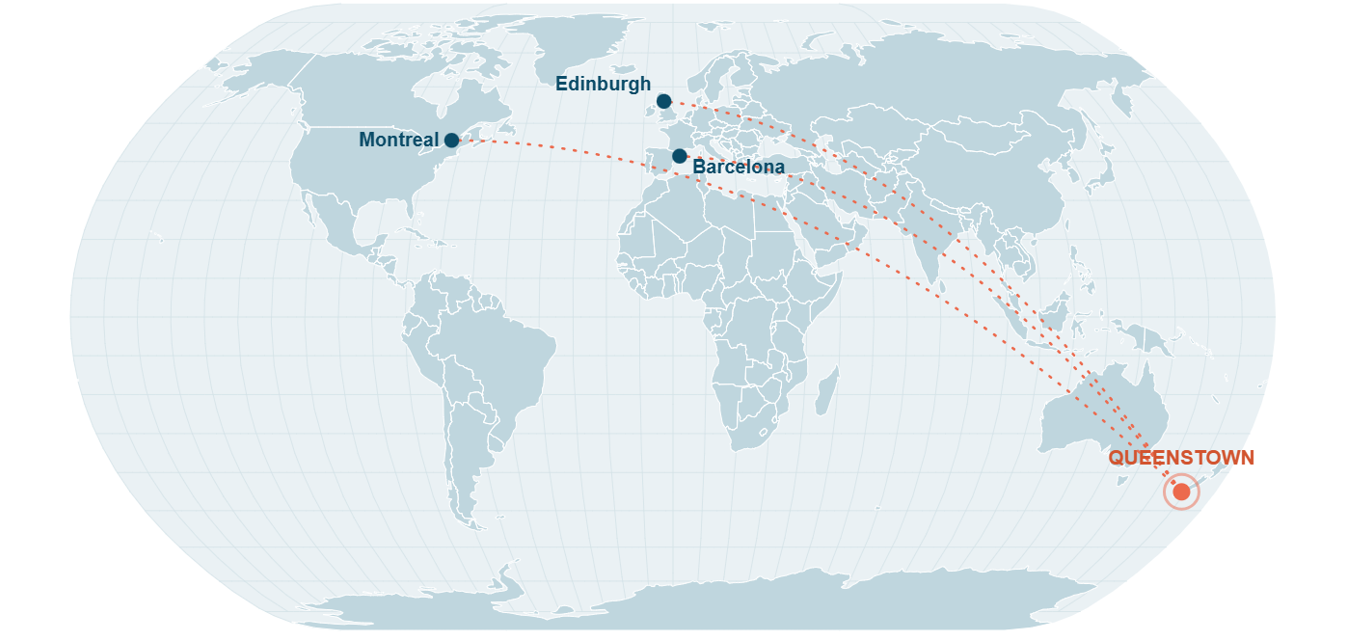
Innovation at the world’s edge: Queenstown’s active Travel Tech collaboration network - Edinburgh, Montreal and Barcelona.
None of this was dreamt up on a chairlift. Over the past two years TQ has visited and studied the world’s most closely studied Travel Tech ecosystems: the Edinburgh cluster, MT Lab in Montreal, the Barcelona cluster, the Singapore Tourism Board’s reverse-pitch programme and Plug & Play in Palo Alto. Each taught something different.
The Edinburgh cluster is a university-led model, catalysed by Skyscanner’s sale to Trip.com. Its programme head visited Queenstown this year for the University of Otago’s Tourism Policy School, leading to collaboration discussions with TQ.
Montreal’s MT Lab runs a deliberate tri-party compact between academia, government and industry, in which corporates table their unmet problems through a reverse-pitch format and startups respond. A promising collaboration is in development.Barcelona, meanwhile, has built a cluster of roughly 150 Travel Tech companies and runs a five-month accelerator course. Less structured, but highly effective, with support from several local universities and corporates.
The lessons repeat with almost boring consistency across every Travel Tech startup ecosystem we’ve studied. A destination needs the same institutional and infrastructure pillars to be successful: connectivity with the rest of the world, a committed leader to drive funding and political commitment, a DMO for legitimacy and market access, and a university for talent and research.
Once again, focus is everything. Volunteer-only efforts tend to stall, and the clusters that try to do everything - members, events, innovation and projects all at once - seem to achieve less. And here’s the surprise factor: only a couple of years in, Queenstown already fields a more complete institutional stack than several of these clusters had after several years of effort.
Short and sharp: the Las Vegas lesson
The homework also surfaced an inconvenient truth. Nearly every established startup programme is long, with Montreal running a year-long cohort and Barcelona about five months. But a district of say 50,000 residents is unlikely to be able to fill one. The most useful precedent came from an unexpected direction. Las Vegas, another economy heavily reliant on tourism with a thin local startup base, solved the identical problem with Zero Labs, whose Innovation Launchpad compresses acceleration into three concentrated days for around 20 teams, run with the University of Nevada Las Vegas and the state’s economic development office. Singapore has since migrated its own reverse-pitch from six months down to a handful of days, confirming that it is possible to deliver the high-value parts of the model in days rather than months.
So, the preliminary Queenstown model looks like it will be an accelerator short course of a few days, run a few times a year, mixing local teams with invited outside startups to build capability, skills and a larger cohort of Travel & Hospitality Tech companies. At least one course would use the reverse-pitch format, in which industry and TQ table real problems for startups to solve.
The theory is that together, the academic problem-solving pipeline running through the University’s Masters program and the entrepreneurial pipeline running through the short courses should work a partly overlapping problem set, and feed each other. Over time, as the local pipeline thickens, the ambition is to graduate toward a longer cohort of the kind that Edinburgh, Montreal and Barcelona already sustain.
The coming-out party
Which brings us to this month. TQ has secured the Australasian rights to WiT (Web in Travel), Asia Pacific’s leading Travel Tech media and events platform, and on the 20th and 21st of this month WiT Queenstown makes its debut at the Queenstown Memorial Centre under the theme The Next 20: Innovation at the World’s Edge.

WiT Queenstown 2026 · The Next 20: Innovation at the World’s Edge · Queenstown Memorial Centre, 20–21 July.
The speaker list is the kind normally reserved for Singapore ballrooms: senior executives from Accor, Airbnb, Agoda, Air New Zealand, Booking.com, Expedia, Google, Klook, Viator, Serko, SiteMinder, Webjet and many more, alongside New Zealand’s most senior tourism officials and a strong homegrown contingent. With 60 CEOs dropping in, more than 300 delegates will fill the room for the premier gathering of Travel Tech founders, operators and investors in the region this year. Tickets have sold out, it’ll be standing room only for some discussions, and latecomers to the party are sitting patiently on TQ’s waitlist.
A conference does not build an ecosystem, but it does something an ecosystem cannot do for itself: it puts the place on the mental map of the people who allocate capital and choose where to build. WiT founder Yeoh Siew Hoon has described the event as the world converging on Queenstown to explore innovation at the edge, and as she notes, great things often happen at the edge. When the global Travel Tech elite spends two days breathing alpine air and arguing about agentic AI over central Otago pinot, some of them will do the maths on quality of life, time zones and talent. That is how clusters start.
The honest bit: what could go wrong
An essay like this is worthless without the counterarguments, so here they are.
Housing is the big one. Queenstown’s shortage is well-documented, and a tech strategy that adds 2-3,000 skilled workers over two decades adds demand to a strained market. TQ’s response is threefold: firstly, the district is forecast to absorb around 20,000 new residents over 20 years regardless, so we need 10-15% of the people who move there to be tech professionals who can afford the local housing cost; secondly, larger employers may be able to support dedicated accommodation solutions, partnerships or relocation models and thirdly, workers don’t need to live in the centre of Queenstown - some may choose to live in one of the cohort of amazing settlements near Queenstown, such as Wanaka, Clyde and Glenorchy. A reasonable thesis perhaps - but the sceptics will want to see it work.
Scale is the second risk. A billion dollars of tech GDP is a bold target for a district whose sector was worth less than $100 million when the plan launched. The honest framing, acknowledged from the start, is that even falling short would be a triumph: merely reaching the national average share of tech in the economy will help to transform the district’s resilience.
The third risk is focus drift. Place-based tech strategies fail when they chase every shiny opportunity at once. The Travel Tech cluster decision is the strongest signal yet that this one will not, and the discipline of measuring progress publicly, a habit carried over from the Accenture analysis, keeps the scoreboard honest.
Lastly, Queenstown’s cost structure is not for the faint-hearted. This isn’t Bangalore or Manila - it’s a place that requires deep expertise to be applied to profitable industry verticals if it is to be successful.
Why this matters beyond the Whakatipu basin
There is a blueprint here for other regions. Start with evidence, not vibes. Do your maths. Base all of your assumptions on robust economic modelling, not on guesswork. Be quantitative above all else. Recruit anchor institutions early: a university, an airport, corporates with skin in the game. Pick one thing and become famous for it. Borrow shamelessly from the ecosystems that got there first, then adapt for local scale. Use a globally credible event to compress ten years of awareness-building into two days. And frame the whole exercise around resilience, because the next shock is always coming, a theme we explore at length in the next essay.
For our part, North Ridge Partners committed seed funding to get TQ off the ground, pays its dues every year as a foundation member, and spends an enormous amount of time on this initiative. We back TQ for the same reason we back Travel Tech companies across Asia Pacific: this sector compounds, the region punches above its weight, and the best businesses are often built far from the obvious capitals.
If the next SiteMinder or WebBeds is founded within sight of the Remarkables, nobody at this desk will be remotely surprised.
Roger Sharp, July 2026
FOUNDATION MEMBERS BACKING TQ

Like this article? Join the thousands of tech founders, board members and investors who subscribe to our free monthly newsletter, Tech Round-Up. Sign up below!