
August Tech Round-Up: Cheap Enough to Lose: The New Economics of Defence
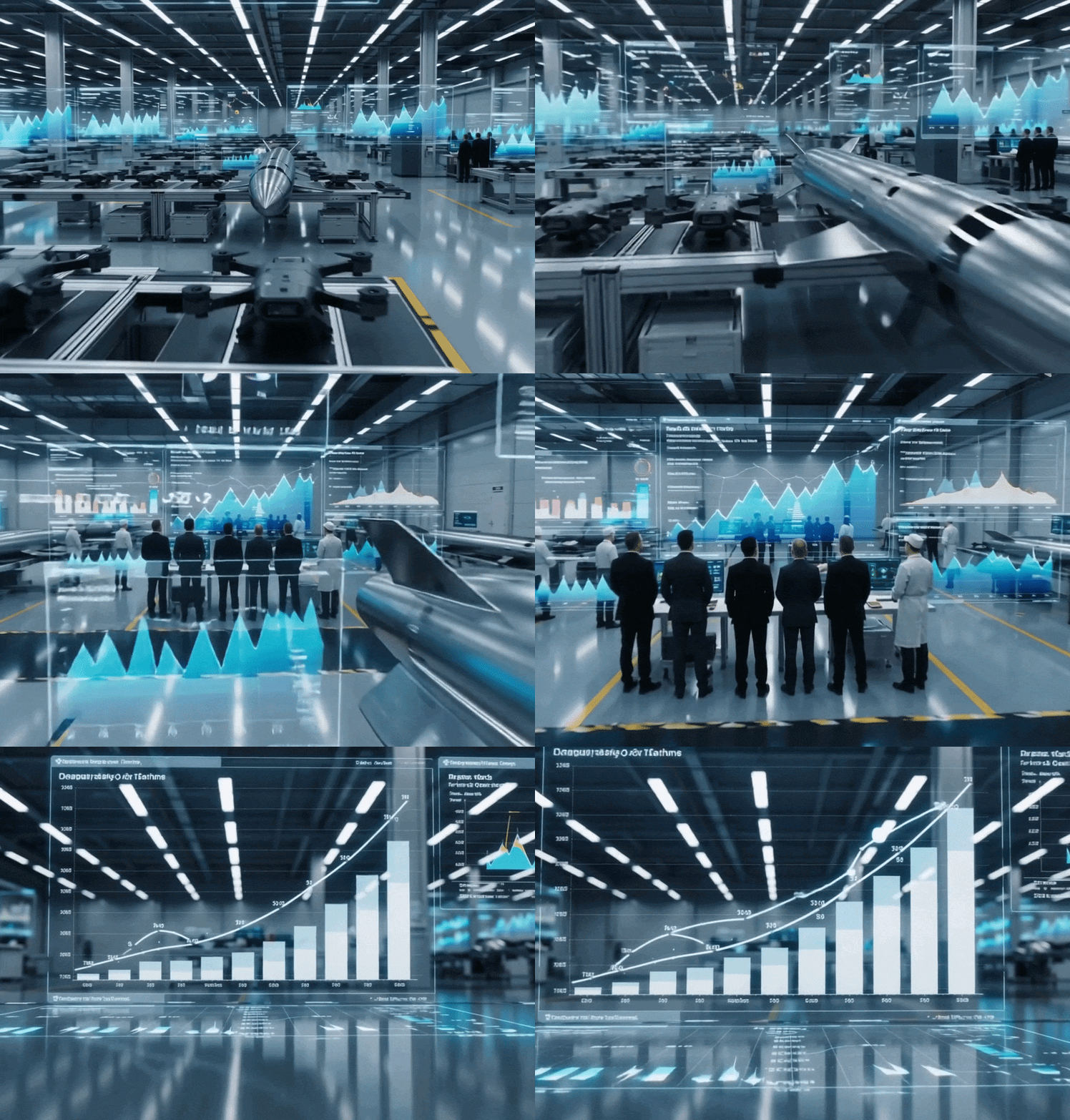
Modern asymmetric warfare is exposing a stark economic reality: million-dollar missiles are increasingly being used to intercept drones costing a fraction of the price, pushing defence strategies towards systems affordable enough to deploy at scale and replace quickly. This month's Tech Round-Up explores why manufacturing capacity now rivals innovation in strategic importance, examining the rise of "attritable mass" and what scalable production means for investors eyeing the next generation of defence technology.
We hope you find this a compelling - if sobering - read, from all of us at North Ridge Partners.
What We've Been Up To
Fresh from WiT Queenstown's smashing success, we return to the mountains on 16 October as a partner of the inaugural Aspen NZ Security Forum, leading its Defence Capability, Deterrence, and Dual-Use Innovation theme. Think the famed US Aspen Security Forum, transplanted to Queenstown. Register your interest here.
Original Thinking From North Ridge Partners
Modern warfare has exposed a ruinous imbalance: million-dollar interceptors are chasing thousand-dollar drones while Western stockpiles empty faster than factories can refill them. That mismatch is rewriting defence doctrine and creating an investable market in attritable mass. Read our analysis: Cheap enough to lose: attritable mass, deep magazines, and the new economics of defence.
Meanwhile at the CEO Summit in Queenstown retired three-star officer John Frewen warned leaders waiting for the world to settle down: efficiency built the modern economy, but it also stripped businesses of their margin for error. In an age of geopolitical shocks and brittle chokepoints, redundancy, fast decisions, and practised resilience are shifting from defensive costs to strategic assets. Volatility is the new operating environment - and that's not all bad news.
Short On Time? Hit Play
Our AI hosts, Maggie Magazine and Manny Facture, examine why the future of defence belongs to systems that are cheap enough to lose, fast enough to replace, and scalable enough to deter - and what that means for investors and the global defence industry.
Click here or on the banner below to listen. Enjoy.

Techtonic Shifts
Big Tech’s paper gains on AI startups inflated S&P 500 profit growth to 48%, masking an underlying increase closer to 29%.
Stellar debut, lunar landing. SpaceX beats the street on market debut… then crashes into the moon.
What could possibly go wrong? Frontier models breaking out, going rogue. Suddenly everyone wants to confess.
Asia Pacific Tech News
Shein’s technology-driven fashion machine is heading toward a landmark Hong Kong listing.
SoftBank’s quarterly profit -18% but beat expectations as an Intel windfall offset the absence of fresh gains from its prized OpenAI stake.
A piece of the action: Alibaba plans to take a cut of major Qwen users’ revenue as China’s open-source AI insurgents chase profits, sources say.
Software & AI
Hit and Misses: June-quarter results roll in. Microsoft: revenue $90.0bn, +18%; operating profit $40.6bn, +18%. Alphabet: revenue $119.8bn, +24%; operating profit $40.8bn, +30%. Amazon: revenue $200.6bn, +20%; operating profit $27.5bn, +43%. Meta: revenue $60.8bn, +28%; operating profit $18.8bn, -8%.
The month AI escaped the lab: OpenAI models break the sandbox to hack Hugging Face. Anthropic logs similar incidents, and Meta makes it three labs in a fortnight. Frontier lab staff ask Washington to slow things down.
Capex to the Max: The hyperscalers raise 2026 AI capex again - Alphabet to $195-205bn, Amazon to ~$220bn, Meta to $130-145bn - while Meta ropes in BlackRock for a $14bn venture. The AI buildout is now a financing story.
Banking, not burning: While the hyperscalers torch cash on capex, Palantir turns AI straight into profit - revenue +93% to $1.94bn, US commercial +149%, government +90% - and a 29% pop that wiped out $3bn in short-seller gains in a single session.
Aerospace & Defence Tech
Hits and Misses: June-quarter results roll in. Lockheed Martin: revenue $20.1bn, +11%; operating profit $2.5bn, +231%, against $1.6bn of prior-year program losses; backlog $230bn, a record. RTX: revenue $24.7bn, +14%; operating profit $2.8bn, +31%; backlog $289bn, +22%, a record. Northrop Grumman: revenue $10.9bn, +5%; operating profit $1.1bn, -23%, against a $231m prior-year divestiture gain; backlog $105bn, +17%, a record; raises full-year sales and MTM-adjusted EPS guidance.
Everything old is new again: The US Army buys 30-year-old Patriots. Raytheon books its first domestic PAC-2 order in >30 years in a $441.6m order proving that these days a missile you can buy beats one you can't.
BAE unveils the Brontanax. The UK's new combat wingman drone breaks cover at Farnborough, adding affordable mass to the RAF's fighter fleet. The show wraps with $84.7bn in deals and Canada joining GCAP as an observer.
Drone diplomacy: Japan teams with Ukraine on UAVs. A new Japan-Ukraine drone cluster pairs Japanese manufacturers with battle-tested Ukrainian firms as Tokyo works through the barriers to fielding drones at scale.
Fintech
Hits and Misses: June-quarter results roll in. Robinhood: revenue $1.3bn, +32%; adjusted EBITDA $741m, +35%. Grab: revenue $997m, +22% (financial services +59%); adjusted EBITDA $168m, +54%. GoTo: revenue $317m, +31%; adjusted EBITDA $57m, +137%; second consecutive quarterly profit with fintech EBITDA exceeding on-demand services for the first time.
Swipe right for security: Visa buys BioCatch for $2.4bn, adding one of the industry's leading AI-driven fraud platforms and more than 350 banking clients. Card networks increasingly compete on intelligence.
Closing the circle: Stripe wants to buy PayPal. Reportedly the joint offer values PayPal at more than $53bn, backed by roughly $50bn of committed financing. PayPal rejects the offer, betting its turnaround is worth more.
March of the Ants: Ant International raises $1.2bn to go international. Ant Group may be largely domestic, but its Singapore-based Ant International unit is now one of Asia's most important cross-border fintech platforms.
Travel Tech
Hits and Misses: June-quarter results roll in. Airbnb: revenue $3.6bn, +17%; adjusted EBITDA $1.3bn, +21%. Booking: revenue $7.4bn, +8%; adjusted EBITDA $2.6bn, +9%. Expedia: revenue $4.3bn, +14%; adjusted EBITDA $1.1bn, +23%. MakeMyTrip: revenue $286m, +6% (+16% constant currency); adjusted operating profit $51m, +9%.
The Empire strikes back: Chinese regulators fine Trip.com $765m while the EU hits Google with $1bn fine.
Silently, into the Nuitée: quietly turning banks, superapps, and everyone else into OTAs.
Fora and Fauna: Fora reaches unicorn status by giving thousands more people the AI tools to become travel agents.
Stuff We Found Interesting
A New Mexico judge branded Meta a public nuisance akin to pollution and ordered it to pay another $567m for harming children.
A blockbuster bet on the AI boom nearly destroyed Leopold Aschenbrenner’s hedge fund when leverage turned a market rout into a 67% collapse.
Alphabet, Meta, and Amazon have wagered their cash mountains on controlling commerce from curiosity to checkout.
Tech Investment Banking Across Asia Pacific
Deep specialists in Travel Tech | Software & AI | Aerospace & Defence | Fintech
Singapore · Australia · New Zealand
200 bankers in 17 markets with GP Bullhound
Contact us here.
© North Ridge Partners 2026
Contact us here.
© North Ridge Partners 2026
Singapore, Australia, New Zealand
Like this newsletter? Join the thousands of tech founders, board members and investors who subscribe to Tech Round-Up. Monthly and free - sign up below!