
Volatility Is the New Operating Environment - And That's Not All Bad News
In July, North Ridge Partners sponsored the CEO Summit at WiT Queenstown, and in doing so managed a small internal first: our Travel Tech and Aerospace & Defence Tech practices in the same room. The two verticals do not cross paths often. The common ground - planes is all we could come up with. We would simply note that when the crossover finally happened in Queenstown, in ski season, our defence lead volunteered to cover it with suspicious speed.
Retired three-star officer and defence strategist John Frewen opened the CEO Summit where he spoke about what a decade of rising conflict risk means for an industry that only works when people, goods and capital can move freely.
He opened with a confession. After a career around national security, he remains optimistic about where the world is heading, yet also pessimistic about the next decade of conflict risk. And he sees no contradiction in that. His message to the room was that leaders will need to get comfortable with the cognitive dissonance that comes from holding both ideas at once.
Frewen’s starting point was the spectrum of conflict. War rarely arrives as a single declared event. It escalates and de-escalates along a continuum, shaped by what Frewen calls latent force: the deterrent weight of capability that is never used but always understood to exist. When deterrence holds, crises are prevented before they start. When it erodes, they get invited in. That lens matters for how boards should read the flashpoints building over the next decade, with Iran, Ukraine, Gaza, and Taiwan at the top of the list. None of them exists in isolation and none will resolve cleanly. For commercial planners, the danger is rarely the headline event itself. It is the second and third-order effects that keep rippling long after the news cycle has moved on.
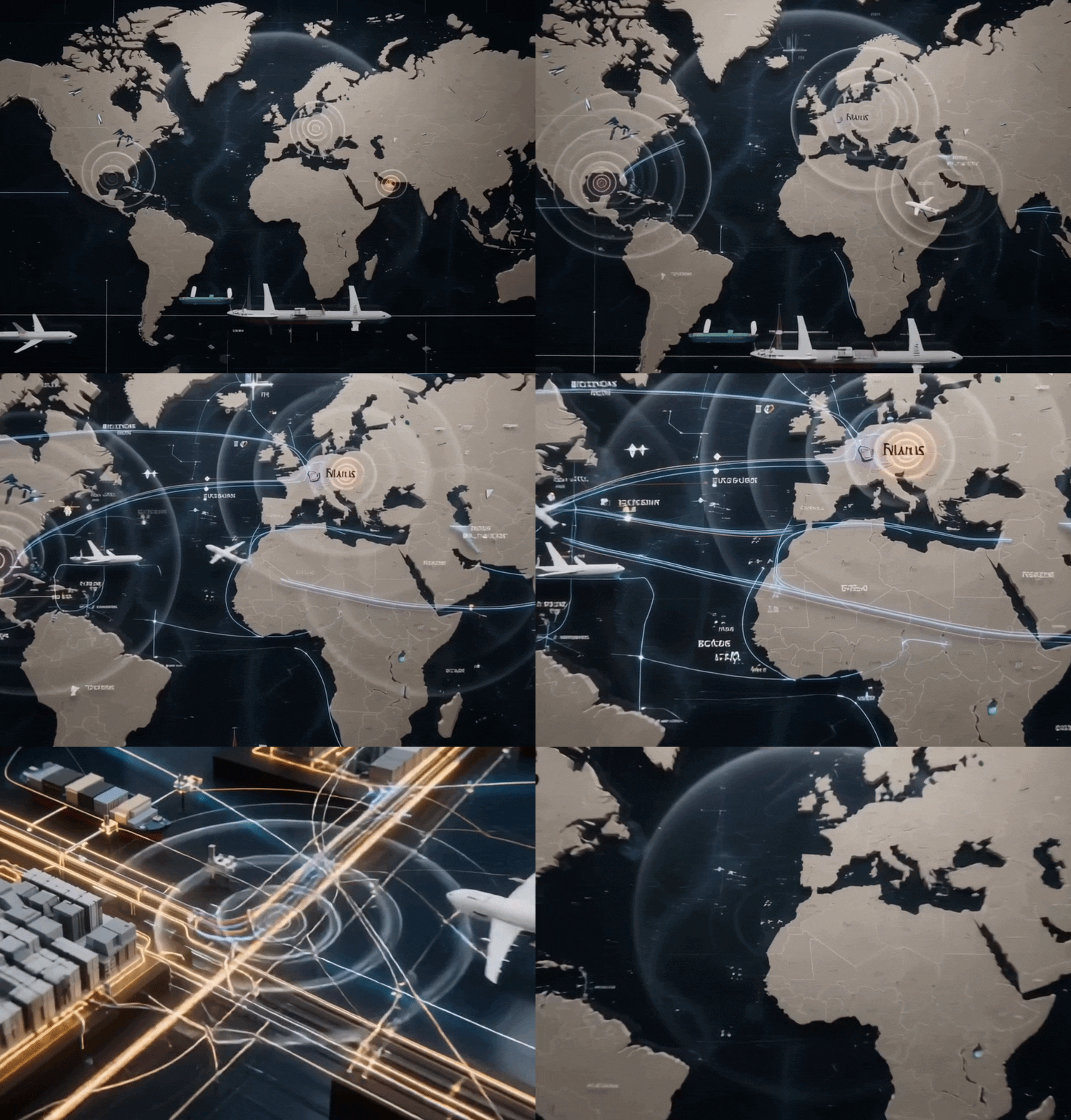
Those ripples concentrate at chokepoints, and Frewen defined the term widely: straits, ports and airspace corridors, but also undersea cables and cloud infrastructure, chip supply and satellite navigation, payment rails, insurance capacity and correspondent banking. Each is a single point of failure for any business that has never mapped its exposure to it. His point is that a regional flashpoint can rapidly swell into a global chokepoint problem.
Aviation and shipping insurers have been living the lesson this year, with war-risk premiums swinging by orders of magnitude within days, and underwriters who once priced policies a day in advance now pricing them hours before departure. Frewen was blunt about what that means. It is not an anomaly. It is a preview of the operating tempo businesses should be planning for.
This is where legacy systems and thin supply chains turn dangerous. A booking platform, a payment processor or a single-sourced logistics dependency can work quietly for a decade, then become the fault line that takes an otherwise healthy business down when volatility spikes.
We don’t need to imagine this since we all recently lived through it. During COVID, just-in-time supply lines optimised over decades for efficiency - and little else - failed when inputs did not arrive, just-in-time or otherwise.
The winners, in Frewen’s telling, are not necessarily the biggest. They are the organisations that built resilience on purpose: predictive analysis instead of retrospective reporting, governance that can make fast decisions under uncertainty, real operational agility, redundancy in the systems that matter most, and decisions made on data rather than gut. He put particular weight on scenario planning and stress testing, practised often enough that the response becomes muscle memory rather than a binder on a shelf.
His closing message was short. Volatility is not a phase to be weathered until things return to normal. It is the new normal, and it will remain the operating environment for the foreseeable future. Businesses that treat the current instability as an exception are setting themselves up to be surprised, repeatedly. But he was equally clear this is not a counsel of despair. Crisis creates advantage for whoever prepared for it. Organisations that posture deliberately for volatility, with the resilience, the data capability and the decision speed to move while competitors freeze, tend to come out the other side stronger, and further ahead than they went in.
If that argument sounds like our lead article this month in different clothes, it should. Whether the subject is munitions stockpiles or the systems behind a booking flow, the lesson is the same: resilience, like deterrence, is built before it is needed.
And this is a recap only. The full session presented in Queenstown to a room full of global travel CEOs was praised as being highly useful and engaging. The frameworks, case studies and practical steps behind the posture are ones John delivers to boards and leadership teams directly. If you would like an introduction, contact us and we will happily make it.