
The Next Airport Expansion Won’t Be Concrete - It’ll Be Code
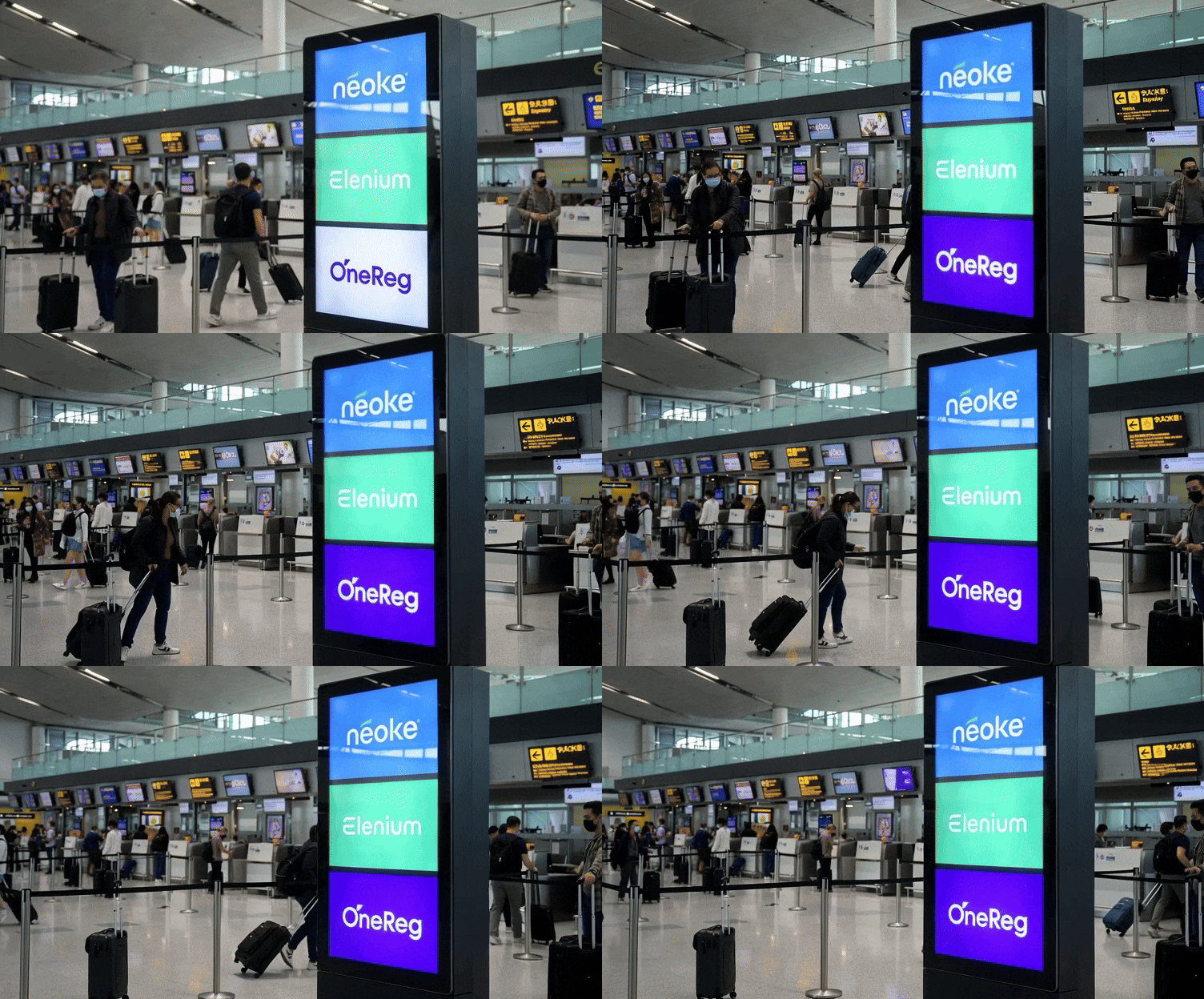
Animation by Grok
As global passenger numbers climb and terminals run out of space, the weakest links in aviation are no longer runways or gates, but the aging systems that decide who can move, who must wait and who is allowed to fly at all. Into that gap has stepped a new class of airport technology firms, among them Elenium, Neoke and OneReg.
Each is tackling a different choke point in the same overstretched machine. Their shared wager is blunt: that airports will not meet rising demand simply by building bigger terminals, but by replacing paper, queues and institutional memory with software that moves faster than concrete ever could.
The hidden cost of standing still
Airports may look modern, but the technology that moves passengers through terminals has barely changed in two decades, according to Aaron Hornlimann, CEO of airport automation firm Elenium.
Despite widespread self-service kiosks, passenger processing remains slow, fragmented and frustrating, especially at check-in and bag drop, where long queues still dominate the experience.
Airport automation promised efficiency but delivered uniform mediocrity. Kiosks became ubiquitous, interchangeable and unreliable, offering passengers a familiar ritual of stalled screens and missing paper. Rather than removing friction from the terminal, technology often embeds it more deeply, dressing old problems in new hardware.
Elenium targets the bottlenecks and poor experiences by automating airline-facing touchpoints, including check-in, bag drop and boarding. Its goal is to let passengers use any available kiosk or bag drop in a terminal, regardless of airline, reducing queues and improving throughput.
It is a market with established competitors such as SITA and Embross, whose common-use systems are tightly bound to legacy hardware and long deployment cycles. Elenium’s counter-position is software-led and hardware-agnostic, trading scale for speed by offering airlines faster rollout and configurable workflows where established suppliers remain slow to adapt.
Hornlimann tells us the industry’s challenge is not a lack of hardware but poor software adoption by airlines. He said around 4.5 billion bags move through the global aviation system each year, but only a small percentage of those are processed through automated bag drops.
“There are enough bag drops physically installed today to do close to one billion bags,” he said. “It is not that the hardware is not there. The barrier has been airlines starting to adopt it.”
The company casts itself less as a hardware vendor than as a software firm that necessarily ventured into machines. Existing airport equipment, Hornlimann says, was too unreliable for an industry allergic to risk. Its bag-drop software is therefore built to run across both its own and third-party hardware, giving airlines a single, global application through which branding and operating rules can be centrally controlled.
Return to value is a core part of the proposition.
In the past, integrating automated bag drop software could take six to 12 months at a single airport. “We have essentially moved that from something that took months into something airlines can configure and deploy very quickly,” he says.
The economics are straightforward. Automating check-in and bag drop can shave between one and two dollars per passenger from airline costs, largely by reducing the need for staffed counters. Tasks once performed by agents can be shifted to machines, cutting labour expenses while increasing throughput.
The firm’s approach is gaining traction. It has signed 22 airlines in the past 18 months and now operates at more than 35 airports globally, including major airports across Australia and New Zealand, as well as locations in Southeast Asia, the Middle East and parts of Europe. In markets like Australia, Elenium holds close to 60 per cent market share in automated bag drop.
As airports and airlines push toward industry targets of 80 per cent self-service by 2030, Hornlimann’s focus now is scale. “If you make it easy for the airline and there is a strong business case, they will adopt it,” he said.
One face, many airports
Airports are running out of space, not passengers.
Global air travel is forecast to roughly double by 2040, yet most major airports were built decades ago and have limited room to expand. That is forcing operators to find ways to move more people through the same infrastructure while managing rising security and data risk.
Neoke, a travel technology company focused on digital identity, says the solution lies in changing how passenger identity is verified. It is playing in a fast-forming stack alongside large biometrics providers (IDEMIA, Amadeus/Vision-Box) and travel infrastructure players (SITA, Indicio), with differentiation centred on traveller-controlled identity and reusability across airports.”
The company is building what it calls a trusted traveller infrastructure that allows passengers to digitise passports and biometrics into a digital wallet stored on their own device. Airports and airlines can then verify a traveller’s identity without storing passport or biometric data themselves.
“Neoke, in a nutshell, is trusted traveller infrastructure, and it is trusted because we use a decentralised solution allowing the traveller to own their identity data,” says Timmo Rol, Neoke’s Head of Aviation.
Today, many biometric systems require passengers to hand over passport and facial data to each airport they travel through. Rol said that the approach creates significant security and scalability problems. “If there’s 1500 airports globally that have over a million passport and biometrics data stored for travellers, they become a honeypot for hackers.”
The company’s model keeps that data with the passenger and relies on shared standards so identity credentials can be verified across multiple airports and airlines. That allows travellers to enrol once and reuse their credentials rather than repeating the process at every airport.
The company last year ran a proof of concept at Hong Kong International Airport that allowed passengers to move through bag drop and identity checks using facial recognition alone. The trial reduced passenger touchpoints by about 40 per cent, improving flow through the terminal.
It is now implementing the technology into production and is focused on scaling deployments with airlines, airports and aviation technology providers.
Beyond identity verification, the company plans to layer automation on top of trusted identity, enabling systems that can check passengers in, validate visas and issue boarding passes automatically. “It almost becomes like you have a digital twin that can act upon yourself when travelling,” Rol says.
Paper trails at jet speed
OneReg, a New Zealand aviation compliance software company, is pitching airports and airlines on a blunt promise: move faster, safely, by turning regulations and audit evidence into a searchable digital system rather than a trail of Word and Excel files.
Competing in a small but growing niche of aviation-compliance software, OneReg operates alongside specialist platforms such as TADERA and Air Trail, within a broader market of digital tools designed to automate safety, audit and operational oversight for airports and airlines.
Clint Cardozo, the company’s CEO and co-founder, says the platform digitises regulations that are typically published as PDFs or Word documents, then links those rules to an operator’s manuals, procedures and reporting so airports can prove obligations are being met when regulators or auditors ask.
The timing is being driven by a squeeze on operating efficiency after COVID-19, alongside rising regulatory complexity and a wave of infrastructure upgrades.
“We are in that 40-year change cycle,” Cardozo says, describing airports globally as due for major renewal.
OneReg says it is now operating in four countries, with customers spanning airports, airlines and ground operations. Cardozo says the company has “80 per cent of the New Zealand airports” as customers and is “fast growing in Australia,” including some smaller airports serving the mining sector. In the Middle East, it works with “the biggest airport in the UAE,” and it has recently entered the United Kingdom, with more airports expected to sign.
The commercial dividend is not subtle. By compressing months of compliance work into days, digital assurance turns regulatory change from a grinding, people-dependent exercise into something closer to an industrial process. Time is saved, effort reduced, and crucially, the outcome is auditable, delivering a paper trail that does not depend on who happens to be on leave or who still remembers how the last change was implemented.
There is a blunt management test at the heart of the proposition. If a CEO or airport operator cannot, within half an hour, surface a clear answer to a basic compliance question, then the organisation is already carrying hidden risk. In that case, the argument runs, manual processes and institutional memory have quietly become liabilities - and automation is no longer optional.
The main obstacle is inertia. “This is the way we’ve always done things,” Cardozo says, adding that the platform touches many departments and requires internal alignment.
As with his peers at Elenium and Neoke, the priority now is to scale. Cardozo calls OneReg a small company from New Zealand with big ambitions that needs to reach more operators and regulators faster.
All three firms represent businesses with a keen eye for a market with a hefty chunk of opportunity around automation, even as each tackles a different challenge. For investors, the opportunity doesn’t necessarily lie in airports that grow bigger, but in the systems that help businesses quietly turning congestion, compliance and identity into scalable, defensible revenue streams as aviation’s next capacity upgrade. Growth plus infrastructure-like qualities. What’s not to like?
Like this article? Join the thousands of tech founders, board members and investors who subscribe to our free monthly newsletter, Tech Round-Up. Sign up below!