
The Future of Payments May Sit Inside Business Infrastructure
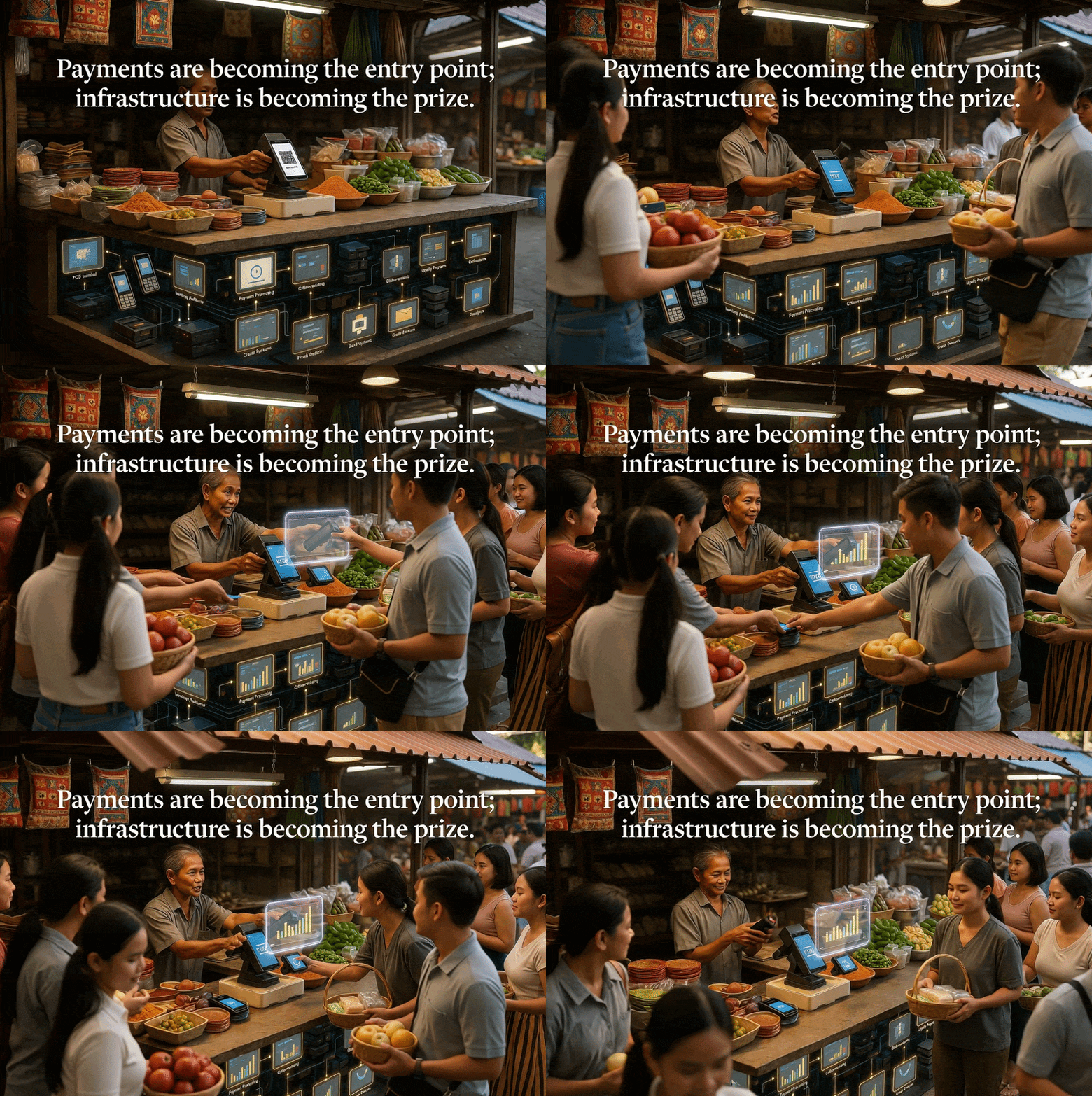
Animation by Grok
Payments in Southeast Asia have a commoditisation problem, and those companies that recognise it earliest are already pulling clear of those that do not.
Every major market now has its own real-time payment rail - Indonesia's QRIS and BI-FAST, Singapore's PayNow, Thailand's PromptPay, Malaysia's DuitNow, the Philippines' InstaPay. These systems have dramatically lowered the cost and complexity of moving money, even beyond borders. The hard work of getting merchants and consumers onto digital rails, which was the defining challenge of the last decade, is largely done.
The competitive question has therefore changed entirely. The question is no longer who can accept payments, but who owns the ecosystem that surrounds them.
Why Southeast Asia Is Different
Globally, the shift from transactional to workflow-embedded business models is not a new playbook. Stripe, Block and Toast demonstrated that combining payments with operational software creates more defensible businesses.
Southeast Asia's version looks different though. The challenge for fintech companies is that the region often looks far more integrated from the outside than it does on the ground.
Jake Lin, Head of Corporate Development and Capital Strategy at Xendit, says one of the biggest misconceptions among investors and global payments companies is treating Southeast Asia as a single market.
"People think of Southeast Asia as this one blob," he says. "That's not really one blob."
The reality is considerably complex. Every market has its own regulatory frameworks, payment rails, banking relationships and compliance requirements. Building a platform that can operate seamlessly across those environments requires much more than connecting payment endpoints.
"It's almost like Game of Thrones, every little country has their own little system and rules," Lin says. "And you've got to be able to connect that. You've got to connect a very ugly jigsaw puzzle."
That complexity is becoming increasingly important as payment processing itself becomes more competitive. While merchants can often access similar payment acceptance capabilities from multiple providers, building and maintaining the infrastructure, licences, banking relationships and operational capabilities needed to move money across multiple Southeast Asian markets remains significantly harder.
For companies that established those foundations early, the barriers to entry have become increasingly difficult for competitors to overcome. Lin argues that scale alone is not the advantage. The advantage comes from having already built the underlying infrastructure.
"We do benefit from early entry," he says. "And we benefit from creating all of the necessary highways – you can't just have another highway builder come in and try to build the same thing over the same piece of land."
That suggests that the next phase of competition may be less about processing payments and more about owning the infrastructure that sits behind them.
The Indonesian playbook
Indeed, Xendit provides the clearest example of the approach in Southeast Asia. What began as a payments API provider has evolved into a broader financial infrastructure platform supporting disbursements, collections, invoicing and embedded financial workflows across multiple markets. Customers rely on Xendit not simply to process payments, but to run critical elements of their financial operations.
The same evolution is visible across the region. Qashier combines POS software, payments, loyalty, inventory management and merchant workflows into an integrated operating system for SMEs across Singapore, Malaysia, Thailand and the Philippines. Fiuu continues expanding across regional payment corridors. 2C2P has repositioned itself as a broader commerce infrastructure platform.
The companies pulling ahead are no longer just processing transactions. They are running parts of their customers' businesses, and merchants who allow that level of integration often find it difficult to walk away. As payments commoditise, competing on acceptance capabilities or price alone becomes harder to sustain. The businesses with staying power are the ones sitting inside their customers' operations rather than on the edge of them.
Why AI makes this more important, not less
A platform that touches a merchant's inventory, payroll, collections and loyalty programme sees far more than a payment gateway ever could. That depth of data makes for better credit decisions, sharper fraud detection and more useful cash flow insights. It also, frankly, makes the platform much harder to replace.
As AI gets woven into more business processes, the companies that will benefit most are not necessarily those with the most sophisticated models. They are the ones with the richest understanding of how their customers actually operate every day. That knowledge lives in the workflow, not in the transaction log. The platforms already embedded in their customers' operations are sitting on exactly that, whether they have fully realised it yet or not.
The next generation of fintech winners
The payments story is part of a much broader fintech reset taking place across Southeast Asia. We explore that theme further in our companion article: Indonesia FinTech's Reality Check Could Forge Stronger Regional Champions. Indonesia's governance reset and Southeast Asia's payments evolution may look like separate stories. At their core, though, they are expressions of the same underlying shift - a market that has stopped rewarding companies for showing up and started rewarding them for being genuinely useful and hard to replace.
The next generation of fintech leaders will not be defined by transaction volumes or customer counts. They will be defined by how deeply they are embedded in the infrastructure and data flows behind those transactions.
Indonesia's fintech reset may ultimately be remembered not for the scandals that triggered it, but for the regional champions it forged.
Like this article? Join the thousands of tech founders, board members and investors who subscribe to our free monthly newsletter, Tech Round-Up. Sign up below!