
Big Tech’s AI Ambitions Come with a Mounting Debt Bill. Eventually, Somebody Has to Pay
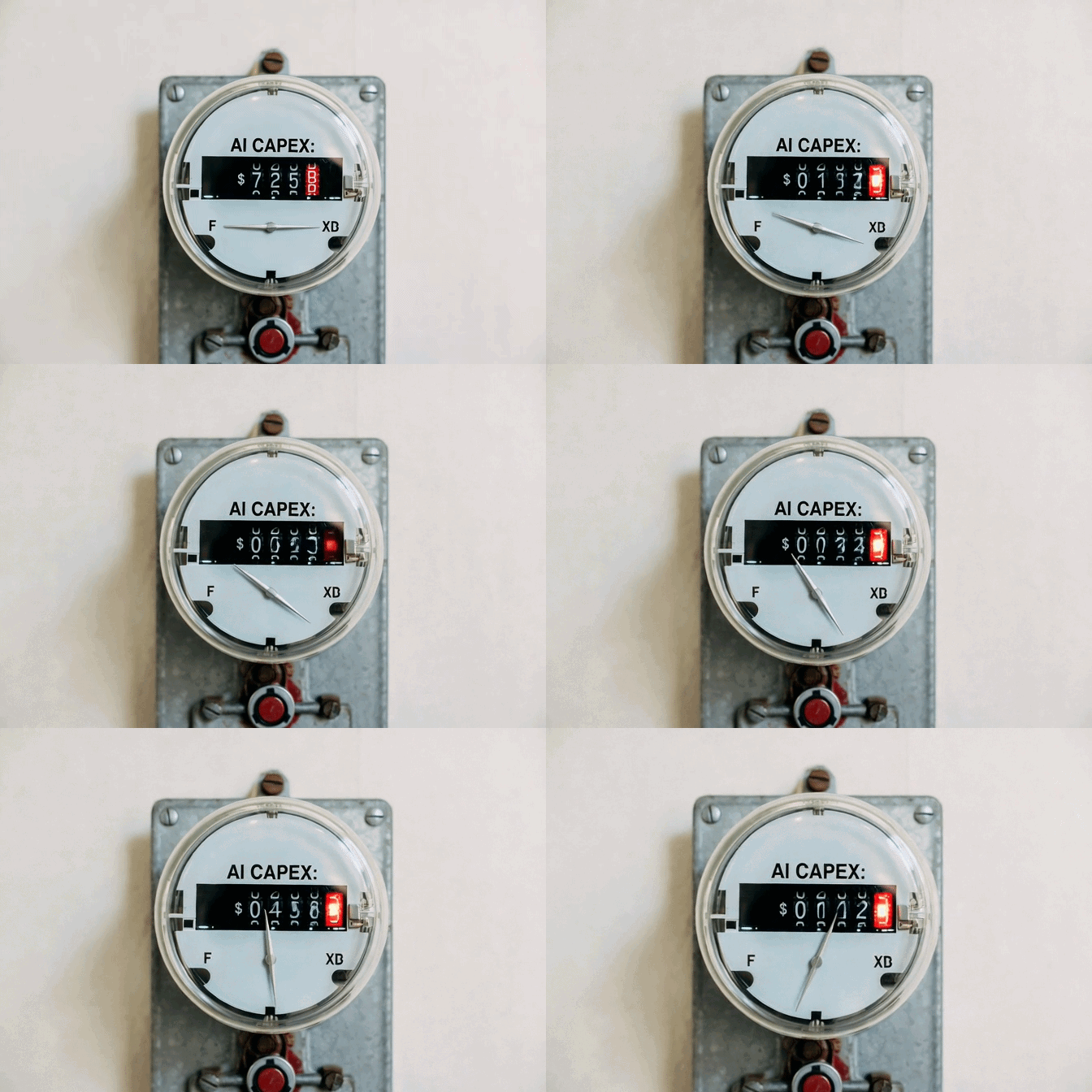
Animation by Grok
Tokenmaxxing is de rigueur in Silicon Valley these days. Developers boast about the amount of tokens they are spending with the same alacrity with which early dotcom entrepreneurs used to brag about their burn rate. Christoffer Bjelke, a Norwegian software developer, captured the zeitgeist precisely in late April when he posted on X, "We hired a junior developer to write the simple code, so we don't have to spend a ton of money on tokens for the basic primitive tasks."
Wall Street is beginning to ask a harder question: who pays for all those tokens?
The answer increasingly appears to be the bond market, for now.
The artificial intelligence arms race has triggered the largest capital spending surge in technology history, transforming the world’s biggest software companies into something that increasingly resembles infrastructure operators. The debate now dividing investors is no longer about whether AI will reshape the economy. It is whether the companies funding the transformation can generate adequate returns before the cost of building it overwhelms their cash flows.
From software to compute factories
The scale of spending is unprecedented.
By some estimates, aggregate capital expenditure commitments across Alphabet, Amazon, Meta and Microsoft could reach as much as US$725bn in 2026. That is sharply higher than the roughly US$381bn spent in 2025.
Most of the money is flowing into one destination: AI infrastructure. Analysts estimate roughly three-quarters of hyperscaler capital expenditure this year will fund data centres, graphics processing units, custom AI silicon, networking and the energy systems required to operate them.
The spending spree reflects a brutal competitive reality.
The AI race is no longer simply about who has the best model. It is increasingly about who can finance the largest compute factory.
That shift is beginning to reshape the financial profile of the so-called Magnificent Seven, who, in addition to the hyperscalers mentioned earlier, include Nvidia, Apple and Tesla.
The cash flow squeeze
For years, the largest technology companies were celebrated for their ability to convert profits into enormous free cash flow. Now, much of that cash is being recycled directly back into infrastructure. Analysts project Alphabet’s free cash flow could fall below US$10bn in 2026 as capital expenditure accelerates. Barclays estimates Microsoft’s free cash flow could decline by more than a quarter. Amazon's position is even more striking. The company spent roughly US$128bn on capital expenditure over the past four quarters, up approximately 65% year-on-year, leaving free cash flow of about US$11.2 billion.
Some analysts now expect Amazon’s free cash flow to turn negative this year as capital spending rises toward US$200bn.
Enter the bond market
The consequence is that companies that once funded expansion comfortably from operating cash flow are increasingly turning to debt markets. Hyperscalers issued roughly US$121bn in new debt during 2025, according to market estimates, with more than US$90bn raised in the final quarter of the year alone. Morgan Stanley estimates technology hyperscalers could borrow another US$400bn during 2026.
Alphabet recently completed a US$20 billion bond sale that reportedly attracted more than US$100 billion in investor demand, according to Bloomberg.
Fixed-income investors have begun paying closer attention.
The weighting of Meta, Alphabet, Amazon and Oracle in major US corporate bond indices has risen sharply over the past year as AI-related debt issuance surged. Credit default swap spreads, a form of insurance against corporate defaults, have also widened across several major technology issuers.
An echo from the late 1990s
The concerns are not purely financial. They are historical.
Compare the current AI buildout with the telecommunications infrastructure boom of the late 1990s. During that period, telecom operators spent hundreds of billions of dollars building fibre networks under the assumption that owning infrastructure would guarantee future dominance.
The infrastructure itself proved essential. The internet economy that followed depended on it.
But many of the companies that financed the buildout generated poor shareholder returns or collapsed entirely after capacity ran ahead of monetisable demand. WorldCom and Global Crossing went bankrupt. Level 3 was eventually acquired at a fraction of its peak valuation.
Of course, there are some important differences this time. Alphabet, Microsoft, Amazon and Meta remain enormously profitable businesses with global scale and entrenched market positions.
But the similarities are becoming difficult to ignore.
The logic driving the spending is fundamentally winner-takes-most. No major hyperscaler wants to risk falling behind in compute capacity if AI becomes the next dominant technology platform.
That competitive dynamic creates a dangerous feedback loop. If one company expands infrastructure aggressively, rivals are forced to follow regardless of near-term returns.
The additional complication is that AI infrastructure depreciates far faster than the fibre networks built during the telecom era. Fibre could remain commercially useful for decades. AI accelerators and GPUs may become obsolete within four to six years as newer model architectures demand more powerful hardware.
For investors, the key metric may increasingly not be earnings growth but free cash flow conversion.
The largest technology companies are still generating enormous profits. But those profits are increasingly being consumed by a capital expenditure cycle that shows little sign of slowing.
From software multiples to infrastructure multiples
The market’s view of the sector may ultimately need to change as well.
For most of the past two decades, investors valued Big Tech primarily as software businesses: asset-light, scalable and capable of producing extraordinary margins.
The AI era may force a partial re-rating.
Some parts of the market are beginning to look less like software and more like infrastructure - businesses defined not only by innovation and growth, but by power access, financing structures, depreciation schedules and the ability to sustain massive capital programs over long periods.
The bond market appears to have noticed already.
Equity investors are still deciding.
Like this article? Join the thousands of tech founders, board members and investors who subscribe to our free monthly newsletter, Tech Round-Up. Sign up below!