
AI Gets Smart - Markets Get Sceptical: Why Execution, Not Hype, Wins in 2026
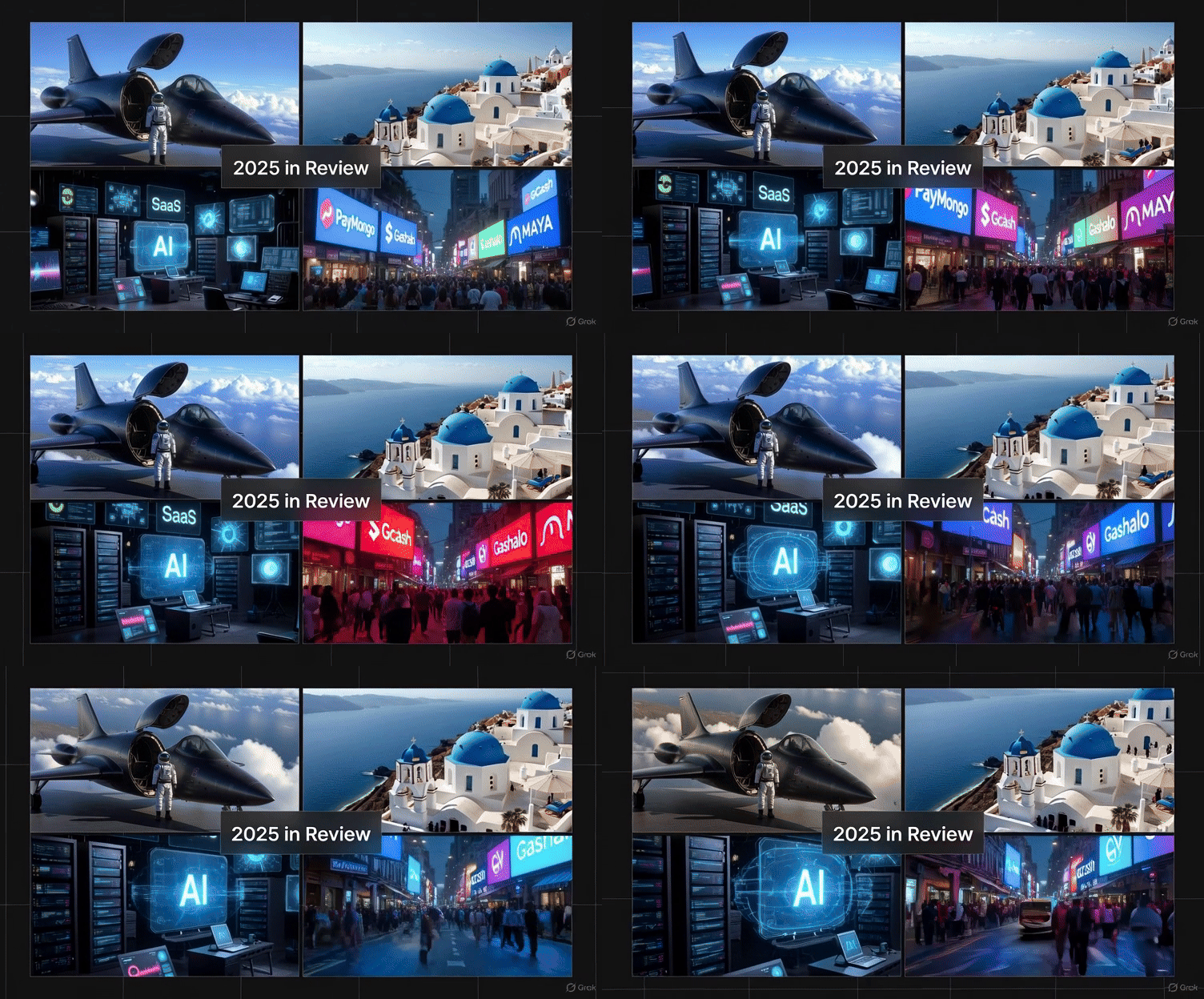
Animation by Grok
The promises of artificial intelligence are finally colliding with the limits of markets, institutions and code. In travel, smart systems aspire to remember our whims yet still mis-book our flights; in B2B software, copilots are lauded as colleagues even as governance failures threaten to derail productivity. Fintech, once drunk on growth, sobers up to regional realities where phoenix stories coexist with ruthless consolidation. And Aerospace & Defence Tech, flush with cash, discovers that machines are cheap, but capacity is scarce. Across sectors the pattern rhymes: intelligence is abundant, but trust, capability and business models lag behind, leaving investors to favour the grounded over the grandiose.
Travel Technology (Roger Sharp)
What we wrote this year: Hey Siri, Take Me to Santorini and ByteDance is Tearing Up the Online Travel Playbook
What we think: The travel industry has long promised to “know” its customers, yet 2026 may be the year when that aspiration finally inches towards reality. Hyper-personalisation powered by large language models capable of remembering preferences beckons a future in which digital identity shifts from being platform-owned to user-controlled. Our column Hey Siri, Take Me to Santorini set out how voice-driven intent could reshape discovery; the next turn is toward systems that not only hear but recall, assembling itineraries as if they were old acquaintances. Still, like most revolutions, this one starts in fragments. The plumbing for secure, user-centric identity remains immature, hence the admonition to “watch this space”.
Meanwhile, the B2C booking funnel continues to dissolve. Influencers on TikTok and Instagram are reaching further into the transaction layer, not merely inspiring wanderlust but converting it.
And new standards like Model Context Protocol are making it far easier for AI teams to stitch together supplier APIs into comparison engines and packaging tools, accelerating a shake-up of the current travel distribution order. Which means that natural-language discovery, whether spoken into a handset or typed into a chatbot, will bypass traditional search hierarchies and scatter demand across multiple paths. Witness the major travel brands (airlines, OTAs, metasearch etc.) that are rapidly hiring “conversational AI designers” and building dedicated teams, signaling that chat and voice-based interfaces are becoming core product infrastructure, not side projects. As foundation models commoditize, differentiation will shift to conversation design and brand voice; however, there is a real risk that ultimate control of the customer dialogue moves to platform assistants like Gemini, Siri or ChatGPT, making deep API integration as important as owning your own conversational front end. Meanwhile Google is (once again) making a big play for ownership of the travel itinerary, stitching together its huge toolkit.
This dynamic echoes the Santorini note: travellers now talk to technology the way they once talked to agents. Platforms unprepared for such fluidity risk being reduced to commodity pipes.
Yet do not expect the machines to rescue them. AI agents may be feted as the new intermediaries, but 2026 will likely expose their brittleness. They will manage simple bookings; for anything more elaborate, disappointment looms. Horror stories of mis-sequenced flights or hopelessly mismatched accommodation will remind consumers and businesses alike that the travel journey remains stubbornly human in its complexity. Those who rush to outsource trust to code may regret it.
Investors, however, will not retreat. Savvy capital will chase those able to turn intelligence into governed capability - firms that deliver results, not rhetoric. In 2026, the smart money watches for capacity, trust and defensible data moats, not just clever code. It’s all up for grabs.
Software & AI (Gerry Gimenez)
What we wrote this year: Will SaaS Survive the AI Shockwave? and SaaS Isn’t Dead, It’s Getting a Brain
What we think: the software industry has spent two decades promising transformation while mostly delivering workflow wallpaper. By 2026, that pretence expires. To understand this tension we conducted a virtual debate where guest columnist, Mi3 Australia Technology Editor Andrew Birmingham argued that the upheavals to be ushered in by agentic AI will so dramatically change traditional SaaS markets as to render their demise. Against that, North Ridge Partners own Gerry Gimenez (Director of Software & AI coverage), argued that AI is driving a major evolution, not replacement, as companies blend AI agents with proven SaaS scalability for the win.
Perhaps the most interesting insight though was where their arguments intersect: both agreed that SaaS cannot remain static; it must build “brains” that do useful work rather than sit passively atop workflows. They concur that pricing models must evolve beyond per-seat licences toward value-linked constructs that reflect delivered outcomes. Each warns that governance and defensibility matter more than hype. Those without data moats, embedded workflows or credible AI economics are at risk. They independently converged on the conclusion that investors will reward platforms marrying traditional SaaS fundamentals with AI-native capabilities. The real disagreement, then, is not whether SaaS survives but whether incumbents can adapt fast enough to remain the eventual beneficiaries.
As to the outlook for next year, we believe that any credible B2B application is expected to now arrive with an embedded copilot that does more than annotate screens; an intelligence that acts on data, not simply fetches it. The race is most frantic among legacy vendors, whose survival now rests on infusing agents into their products, so they resemble colleagues rather than tabs labelled “AI”.
Yet intelligence has consequences. Traditional per-seat pricing begins to creak under the weight of automated labour. If an agent performs work previously done by humans, customers will expect commercial models to reflect delivered results. Hence the emergence of hybrid architectures such as subscriptions blended with consumption credits, or outcome-based fees and dynamic pricing - what you might call “Results as a Service” (RaaS). The earlier essay warned that platforms must “build brains that do useful work”. By 2026, they must also charge in ways that prove it.
This shift demands governance that is currently lacking. The enthusiasm for generative features in sales, marketing and support is untempered by sober guardrails. The result will be visible errors: bad content, leaked data, and regulatory scuffles. Organisations that deploy without workforce planning or AI literacy risk finding that productivity gains stall just when spending peaks. Effectively, the agent narrative has outrun its implementation. Buyers and investors will reset expectations toward narrow, workflow-specific deployments. And they will be supervised systems that stick rather than roam. Expect narrow, supervised agents to stick; broad “autonomy” programmes may be paused or killed pending ROI.
In that environment, data and distribution become moats. Incumbents with privileged datasets and deep workflow embedding are positioned to cross-sell intelligence across suites; point solutions find themselves commoditised by the very AI they adopt. Capital remains available, but its gaze sharpens. Investors want transparent gross margins, credible AI unit economics and recurring revenue that justifies valuation premiums. Giants will keep acquiring AI-native startups, not out of caprice, but because building these “brains” in-house takes too long. In software, survival belongs not to the biggest, but to the most governed and most grounded.
Fintech (John Moore)
What we wrote this year: The Philippines - From “Sick Man of Asia” to Fintech Phoenix
What we think: Fintech’s swagger has mellowed; it’s now more of a strut. Southeast Asia’s post-pandemic exuberance, which was once defined by “growth at all costs”, is giving way to a more chastened mantra: prove it, or partner. In the Philippines, we noted a system transforming from “Sick Man of Asia” to a fintech phoenix, yet the alchemy remains uneven. Mature markets such as Singapore and Malaysia now prize efficiency and profit; Indonesia, the Philippines and Thailand still treat inclusion and scale as imperatives, not luxuries. The result is a bifurcated capital market: funds flow, but selectively.
Investors are tightening the purse strings whilst writing larger cheques. Only category leaders in payments, lending and wealth can expect meaningful rounds. Subscale operators will eye mergers, licence-sharing deals or strategic exits simply to survive. Singapore emerges as the region’s roll-up engine. Cross-border transactions will increasingly run through Singaporean holding companies acquiring teams, licences and portfolios in neighbouring markets, often alongside banks or insurers eager for adjacency.
Digital banks illustrate the split more starkly. In Singapore and Malaysia, they are settling into niche profitability through partnerships rather than chasing volume. By contrast, Indonesian and Philippine challengers continue their hunt for “new to bank” customers, buoyed by growth capital still intoxicated by scale narratives. Wealthtech follows a parallel logic: high-ARPU cross-border platforms for the affluent in Singapore and Malaysia; micro-investment and trading apps bundled into super-apps or banks for first timers in Indonesia and the Philippines.
Embedded finance and Insurtech lubricate this integration. Cross-border payments, built-in credit and bundled protection increasingly permeate e-commerce, mobility and logistics. Minority stakes and acquisitions by banks, insurers and big tech reflect a shared recognition: durable advantage lies in distribution plus embedded capability. The phoenix may be rising in Manila, but it is the well-capitalised consolidators in Singapore who increasingly own the airspace.
Aerospace & Defence Technology (Christin Burns)
What we wrote this year: Emerging Disruptors Shake Up Defence Tech and Hypersonic Horizons: The Thrilling Global Race to Mach 5 and Beyond
What we think: If war is the mother of invention, then procurement is now its stern schoolmaster. Defence budgets across allied nations continue to rise into 2026, yet the limiting factor is not money but muscle: skilled labour, certified suppliers and the industrial base to meet demand. Our earlier examination of disruptors observed a field in which traditional prime contractors are being forced to open their doors to newcomers. The attractive businesses, therefore, are not the loudest innovators but those able to add real capacity and localisation including factories, talent pipelines and sovereign supply chains.
Nowhere is this clearer than in uncrewed systems. Drones, counter-drones and autonomous maritime or subsea assets are shifting from gimmick to programme of record. Similar acceleration is visible in electronic warfare and integrated air and missile defence. The operational lessons from recent conflicts are being internalised: control of the skies and seas no longer belongs solely to exquisite, crewed platforms.
Space and sensing have become the new commanding heights. Governments are moving away from a handful of vulnerable satellites towards resilient, multi-orbit constellations and persistent sensor grids capable of fusing intelligence across domains. Continuous awareness trumps episodic insight. This echoes our reference to “emerging disruptors shaking up defence tech,” where software-first models were eroding monopoly positions.
Indeed, autonomy and AI are no longer fringe; they are mandated. From predictive maintenance to command-and-control, ministries now prioritise suppliers who can blend credible AI with certification, safety cases and sovereign data controls. Yet capability alone is insufficient. Alliances, from AUKUS Pillar 2 to regional industrial policies, are reshaping deal flows. Joint ventures, minority stakes and cross-border roll-ups increasingly reward those who can navigate export controls, IP sharing and localisation rules. Defence technology’s future belongs not to the boldest in rhetoric, but to the firms that can translate AI and safe autonomy into sanctioned capacities within the messy geopolitics of alliance economics.
Outlook
Savvy capital will chase those able to turn intelligence into governed capability, the kind of firms that deliver results, not rhetoric. In 2026, discerning capital will chase proven capability, credibility and data advantage, not merely glittering AI claims.
Like this article? Join the thousands of tech founders, board members and investors who subscribe to our free monthly newsletter, Tech Round-Up. Sign up below!